Workflow Graphic Editor - Business Process Integration Platform
Process Integration • Workflow Execution • Application Gateways
A pilot business process integration platform designed to connect heterogeneous corporate software products within a unified information environment. The platform provided reusable infrastructure for CRM, HelpDesk, document management, order-processing and Call Center solutions and could also serve as an integration layer for ERP and other external systems.
 Java
MSSQL / Sybase
XML / XSL
Java
MSSQL / Sybase
XML / XSL
 Apache Tomcat
JSP
Apache Tomcat
JSP
- Technology PilotValidated reusable integration and workflow architecture
- Message RoutingConfigurable transport for heterogeneous data flows
- Workflow ExecutionScenario-driven business-process orchestration
- Application GatewaysExtensible connectivity for external business systems
Platform Architecture
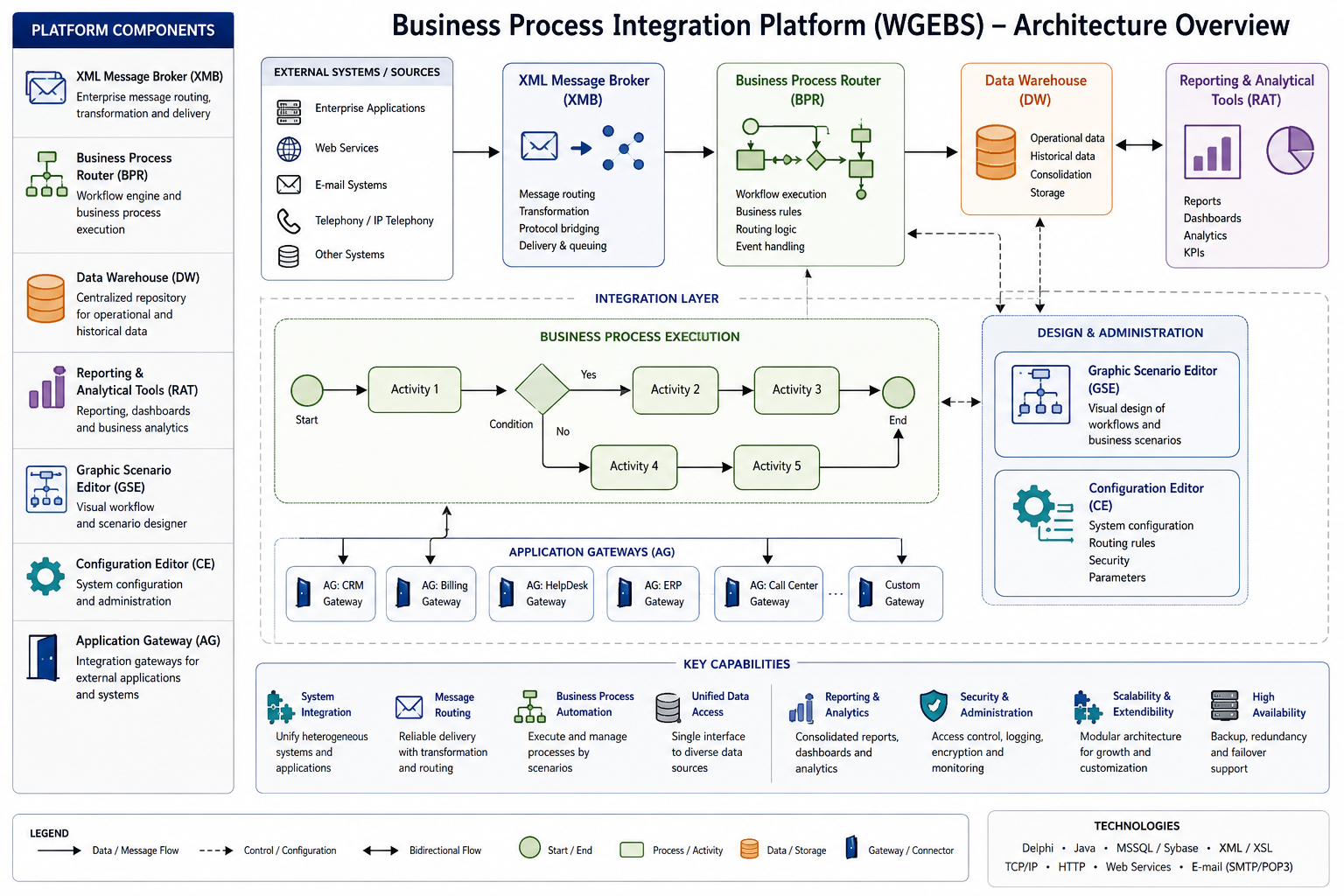
The solution was structured as a set of cooperating servers, shared services and administration tools.
Platform Components
Cooperating Services and Administration Tools
XML Message Broker (XMB)
Message routing server for heterogeneous data flows.
Business Process Router (BPR)
Business scenario processing and workflow execution server.
Data Warehouse (DW)
Centralized data repository based on Microsoft SQL Server or Sybase.
Reporting & Analytical Tools (RAT)
Reporting and analytical subsystem.
Graphic Scenario Editor (GSE)
Graphical editor for business-process scenarios.
Configuration Editor (CE)
Platform configuration and administration tool.
Application Gateway (AG)
Standard or custom gateways providing access for external systems.
Key Capabilities
- Integration of heterogeneous information systems into one scalable corporate environment.
- Centralized message transport with configurable routing of different data flows.
- Unified access to data from heterogeneous sources.
- Integration of geographically distributed systems and users.
- Integration with telephony, IP telephony, web services and corporate email services.
- Centralized storage of data received from multiple systems.
- Scenario-driven business-process execution using graphical workflow models.
- Consolidated reporting, statistics and analytics across connected systems.
- Flexible configuration when business-process logic changes.
- Centralized security, access control, logging and optional encryption of transmitted data.
- Backup and recovery of platform components.
- Modular extension through new components and application gateways.
Workflow Design
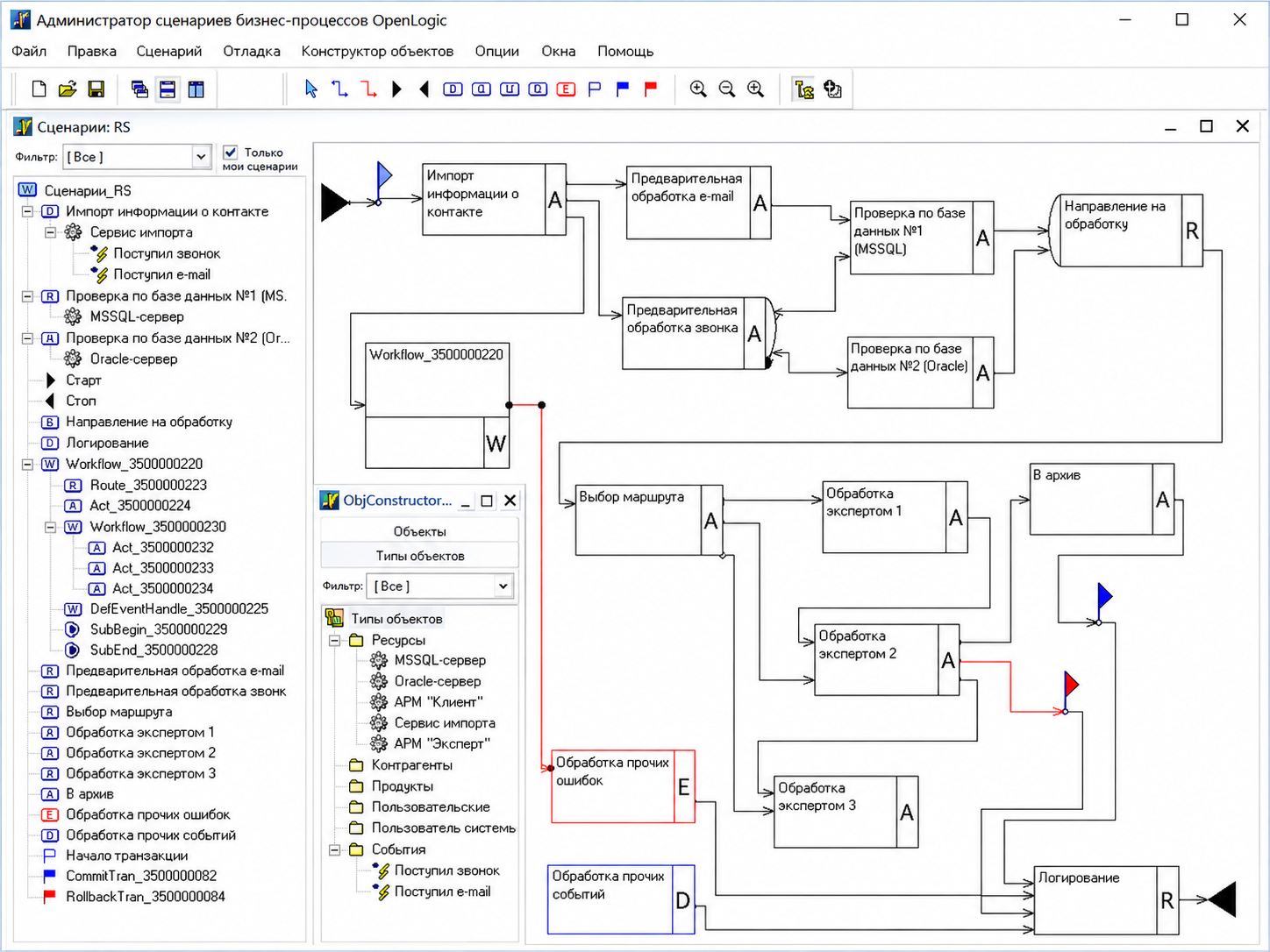
Graphic Scenario Editor
The editor provided a visual environment for configuring workflow scenarios executed by the Business Process Router.
Technology Pilot
Project Significance
WGEBS was developed as a technology pilot. Its primary purpose was to validate architectural concepts, integration mechanisms and workflow-based application design approaches before they were reused in other products and customer solutions.
The resulting components and design patterns later supported CRM, Billing, HelpDesk, Call Center and application-integration projects. The project therefore served not only as a standalone platform, but also as an architectural foundation for subsequent business systems.